(Electronic Design Notebook is a trademark of The Performing Graphics Company)
Sponsored by:
NASA Ames Research Center
Lockheed Corporate AI Center
Lockheed Aeronautical Systems Company
Managing the complexity of design information in large projects is a major problem, particularly the all-important but often neglected conceptual design phase. Compounding the problem is the fact that computer support has never been successful for this phase. Yet involving computers will surely increase the complexity and amount of information to be managed: each designer can generate up to 1000 pages a year of conceptual design documents. The original generator of the documents, as well as later viewers, needs help in organizing and navigating through this enormous amount of information.
An Electronic Design Notebook (EDN) has been built in the vmacs(TM) text-graphic editor. The EDN first supports conceptual design by providing AGILITY for initial conceptualizing, and PROCESSING for annotated drawings expressing those concepts. In addition the EDN supplies ORGANIZATION aid to help manage the complexity of design information. Navigation facilities allow the design or manager to constuct a "map" of a design information space indexed by project requirements. Explanation facilities infer the rationale of design decisions notated in notebook pages.
Publications
1. Lakin, F., Wambaugh, J., Leifer, L., Cannon, D., and Sivard, C., The Electronic Design Notebook: Performing Medium And Processing Medium,' appeared in a special issue of Visual Computer: International Journal of Computer Graphics, edited by Ranjit Makkuni, Springer Verlag publishers, Vol 5, No 4, August 1989.
2. Sivard, C., Zweben, M., Cannon, D., Lakin, F., Leifer, L. and Wambaugh, J., Conservation of Design Knowledge, presented at AiAA'89, 27th Aerospace Sciences Meeting, American Institute of Aeronautics and Astronautics, January 9-12, 1989, Reno Nevada.
3. Lakin, F., Visual Languages for Cooperation, paper for the NSF workshop Technology and Cooperative Work, Tucson, Arizona, February, 1988; to be reprinted as a chapter in Intellectual Teamwork: Social and Tecnical Bases of Collaborative Work, edited by Egido, Carmen, Galegher, Jolene and Kraut, Robert, Lawrence Erlbaum publishers, forthcoming 1990.
4. Lakin, F., Visual Grammars for Visual Languages, published in the Proceedings of the AAAI-87 Conference of the American Association for Artificial Intelligence, Seattle, Washington, July 12-17, 1987.
(vmacs is a trademark of The Performing Graphics Company)
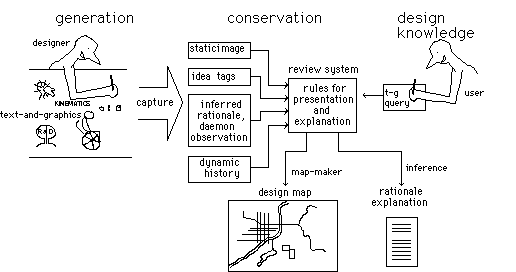
Figure 1. At CONCEPT TIME, while the designer is generating text-graphics representing her design, the Electronic Design Notebook is gathering many kinds of information and knowledge for later use. These include the static image, idea tags, inferred design rationale, observations by interactive "daemons" (monitors), and a dynamic history of the user's text-graphic events. Then at REVIEW TIME a user (either the designer herself or some other person) poses a text-graphic query to the system about a design requirement, and the system automatically creates a map of the relevent notebook pages, and in some cases can explain design rationale.
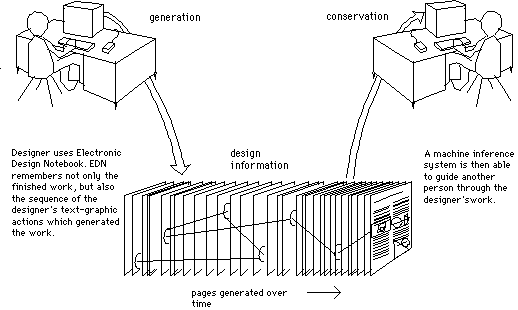
Figure 2. The basic theme in the Electronic Design Notebook is "Laissez faire": voluntary user cooperation and increased assistance with increased cooperation. No special user behavior is REQUIRED in order for the system to provide navigation assistance. And if the user CHOOSES to cooperate and use certain conventions in creating the text-graphics in her design notebook, then the usefulness of the navigation aid will be increased. After the designer enjoys the benefits of cooperation, then she will be inclined to do it more often, thus increasing the usefulness of the navigation aid supplied by the system.
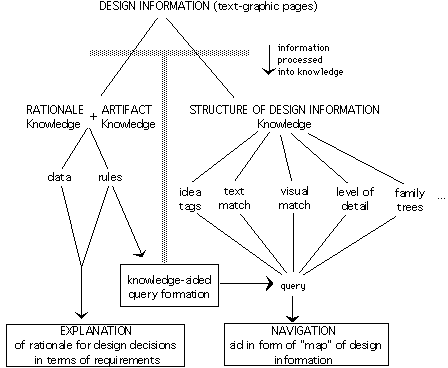
Figure 3. The Electronic Design Notebook is primarily a text-graphic data base of design information. Then various special purpose programs can interpret that information, processing it into design knowledge for use in EXPLANATION and NAVIGATION.
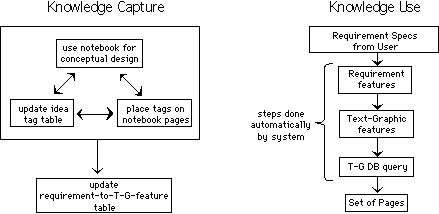
Figure 4. The map-maker system is the heart of the Electronic Design Notebook navigation facility. In the knowledge capture phase, the designer uses the notebook for conceptual design, tagging parts of the notebook with visual markers of the ideas expressed. A knowledge engineer then creates a requirement to text-graphic feature table based on the designers notebook habits; the table is only one page long to cover one hundred notebook pages. Then in the knowledge use phase, the map making system translate a user query in terms of design requirements into a text-graphic data base query, which returns a set of notebook pages dealing with those requirements.