Body Design Highlights
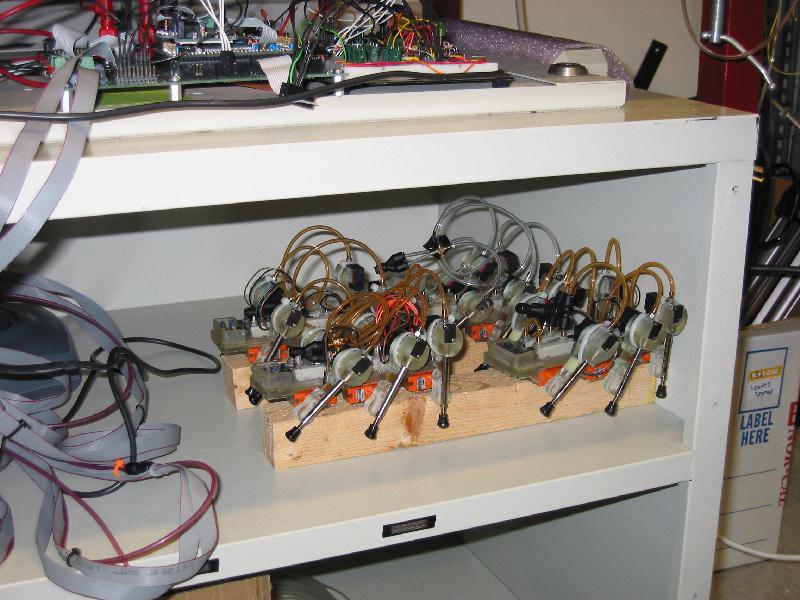
In order to improve leg performance and increase control over the whole body, one valve has been placed on each leg, rather than one per tripod. |
 |
| To supply the proper amount of air to each leg, two air reservoirs are embedded in the body, supplying air to separate sides of the body. |
 |
| A printed circuit board was designed and embedded within the body to simplify internal electrical connectivity. |
 |
| Along the spine of the body, a input/output bus provides access the internal printed circuit board. This provides basic operational connections and allows for extended capabilities (gripper, light sensor, compass, camera, etc). |
 |
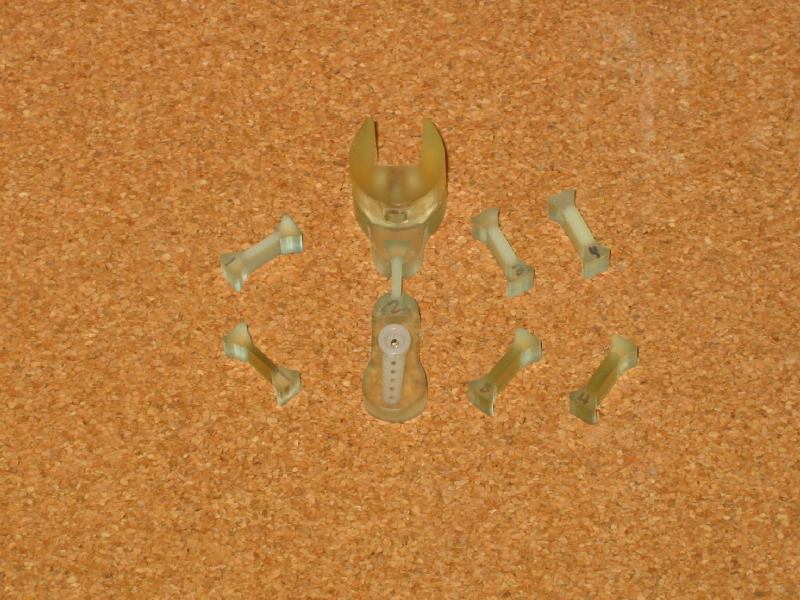
| Interchangeable leg flexures were designed to determine a desirable stiffness range for the legs. These "plug-n-play" (PNP) flexures allow for rapid changes in the leg stiffness between experiments. |
 |
Control
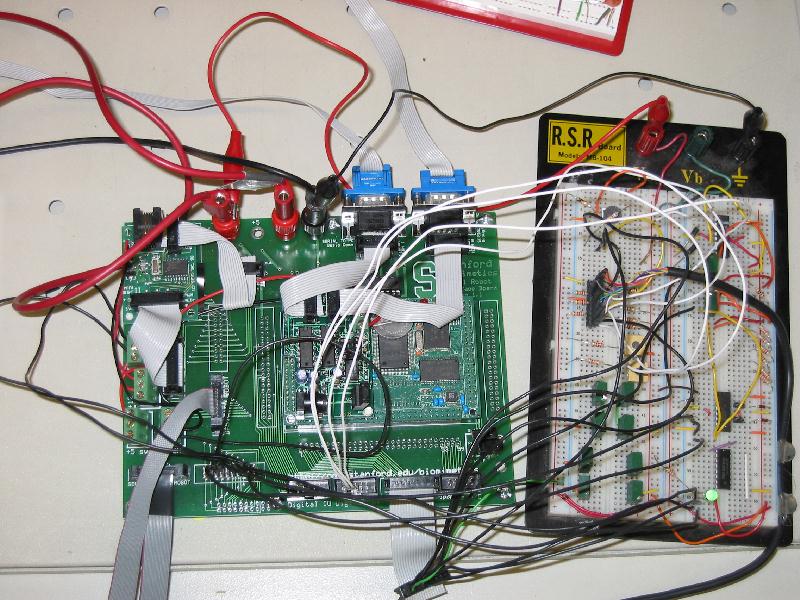
The TERN AE86 microcontroller is the heart of the Sprawlette setup. It includes a AMD186 processor, 19 analog-to-digital (AD) inputs, 3 timers, 5 external interrupts (digital inputs), 14 programmable input/output (IO) and 2 serial communication ports, among other features. It requires a regulated 5V supply. |
 |
| The Sprawlette Interface Board (SIB) is used to connect the TERN board to a PC (not-necessary, but useful for display), the actual Sprawlette body, a servo motor controller, and 2 H-bridge ICs. The SIB also provides convenient access to all the IO capabilities of the TERN, which are used when features are added to the Sprawlette body. |
 |
Body Usage
Body No. | Use |
| 01 | 6 PNP legs, Compass#01, Photodiodesa, Manifolds are fair |
| 02 | 6 fixed legs, Compass#02, Photodiodes, Antenna (RED) |
| 03 | none |
| 04 | 6 fixed legs, STAMP, RF receiver - Porta-Sprawl |
| 05 | none |
| 06 | none |
| 07 | none |
| 08 | none |
| 09 | 6 PNP legs, STAMP setup for solo run w/air supply |
| xx | John Hopkins University,
Laboratory for Human Motor Learning |
| yy | Harvard University,
BioRobotics Laboratory |
| zz | none |