Furthermore, the appendix points to specific application areas where results from this collaboration program can be introduced and tested.
The pedagogical concept revolves around project-based teaching and cooperative learning. Creese (1987a, 1987b, 1988a, 1988b, 1989, 1990) has reported on the Aalborg education in a number of articles.
As Creese (1989) reports in his article, the rationale for project-based teaching at Aalborg University came from a growing dissatisfaction on the part of Danish engineering educators and employers with the deficiencies of traditional "analytical" based teaching. Creese summarizes these primary deficiencies as:
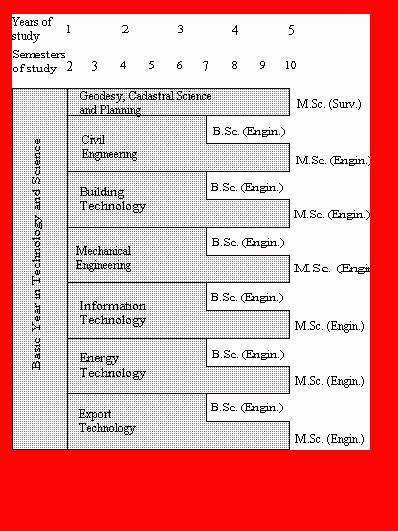
Figure 1 Program of Study in Science and Technology
The goals of project-based teaching are to:
Student groups usually comprise 5-7 individuals. All students in the same group have the same class schedules which alleviates group scheduling conflicts. A unique feature of the program at Aalborg University is that each student group has assigned office space. Due to the popularity of the production and export engineering programs in Denmark, the average group size has increased from about 4-5 students to 5-7 students.
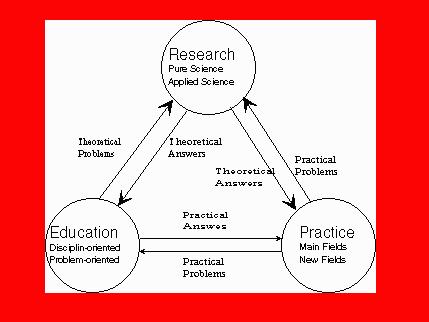
Figure 2 A Dynamic Education Model
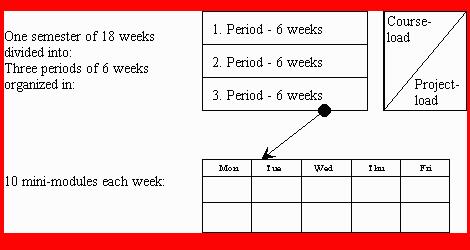
The program format at Aalborg University includes 18 weeks of study plus 2 weeks for project evaluation. These 18 weeks are further sub-divided into three 6-week periods, each sub-divided into 10 mini-modules (seeFigure 3 ). Course work is emphasized most during the initial 6 weeks providing only limited time for project work. The opposite situation occurs in the final 6 weeks when the students' time is primarily devoted to project completion.
Figure 3 Division of the Semester into Periods and Mini-Modules. The change in the division between courses and project work through the periods is illustrated upper right.
A module is 6 mini-modules and is approximately equal to 1 credit hour. The semester has 30 modules which are divided into approximately 13-14 modules for project work, 5-11 modules for project-related courses, 2-8 modules for general courses, and 3 modules for evaluation. The project accounts for an estimated 70% of the total evaluation for the semester. During the last semester, a final comprehensive project is assigned. All projects are evaluated individually on a numerical scale of 0 to 13 with 6 being the minimum passing score.
The final evaluation of the projects is quite thorough and involves an external examination by one or two examiners representing industry or academia. The final written report is typically between 80 - 180 pages. Each group makes an oral presentation to examiners, and any individual in a group may be examined on any aspect of the project.
The project-based teaching paradigm is highly successful at Aalborg University, as approximately 80% of the students complete their degree requirements on time and more than 90% of the graduating engineers assessed the content of the project work as sufficient to their educational needs (Kjersdam and Enemark, 1994). The program has been evaluated by a number of external review panels and also compared to the other major engineering university in Denmark, the Technical University of Denmark (DTU). At the DTU, students follow a traditional style of engineering education. A comparative assessment indicates that while the students at the DTU were stronger in methodology and specialist knowledge, the engineering students at Aalborg University were judged to be stronger in problem solving, communication, and general technical knowledge (Kjersdam and Enemark, 1994).
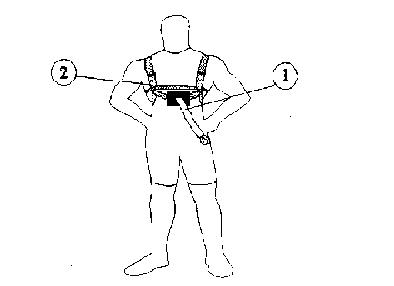
In Fall 1994 the product was a lifeline to be used on board small sailing vessels mainly in rough weather. An illustration of the lifeline attached to a yachtsman is displayed in Figure 4 . The special feature about this belt is that it can vary in length and is self-winding. Furthermore, a patented locking mechanism enables it to be fixed in different.
Figure 4 Illustration of the lifeline attached to a man, (1) the lifeline, (2) harness.
The inventor, who is an experienced yachtsman, has produced the lifeline but has not succeeded in turning it into a sales success. Obviously, the students were encouraged by the fact that the product was a real life product and that their suggestions could potentially be implemented. One project (out of 19) followed the phases presented in Table 1 and their product "redesign" and accompanying business plan were well received by the project examiners from industry and academia.
Tabel 1 Export Engineering Project Phases
As can be seen from Table 1, the project includes a great number of engineering disciplines. The students soon realize that they must determine priorities for their time during the projects. Due to the collaborative learning aspects of the projects, there is a high social pressure on each individual student. Occasionally, a "crisis" occurs when some group members feel that one member did not sufficiently contribute, but this is generally resolved by the students themselves. It is likely that this social pressure can explain the high completion rate for graduating engineers, as discussed earlier.
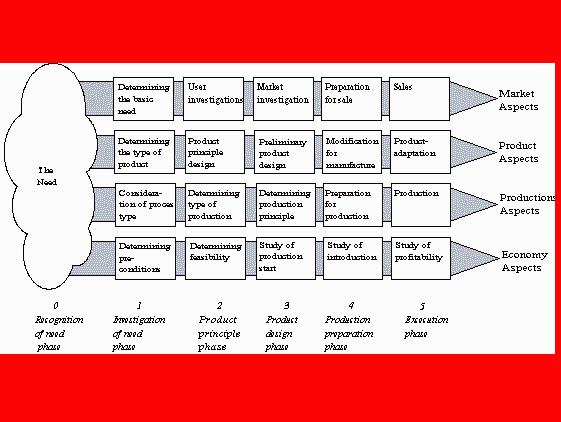
As a common concept for project work as well as for teaching a comprehensive model for product development projects has been formulated (Figure 5 ). The model suggests six phases, each including classes of decisions and considerations with respect to four major aspects: Market Aspect, Product Aspect, Production Aspect, and Economy Aspect.
The model can be used in a number of ways:
Figure 5 An idealized Model for Product Development derived from Andreasen et. al. (1987).
The central course for the fifth semester is a 2 module course titled "Production Preparation". This course comprises introduction to a number of techniques within operations research, methods study, time study, cost estimation, modelling techniques, facility layout, production planning and production control. The term "introduction" is crucial because the real learning is taking place when applying the techniques in the project work. The model illustrated in figure 5 serves as a framework for discussing the interdependence between the decisions made within different phases and different aspects. The following three examples will illustrate this:
Such a task can hardly be overcome by one university alone, and we therefore suggest that parts of the interrelationship depicted by figure 5 could be the subject for an initial collaboration among the participating universities. The contribution can be described as methods for integrating teaching of design and economics within mechanical engineering. In case of realization, we would suggest to include or closely coordinate the effort with a current American initiative founded by the National Science Foundation (Thuesen, et al., 1992, Callen, et al., 1994a, Callen, et al., 1994b).
We recognize that the full benefit would only be achieved if all participating universities could agree on one concept for a project-oriented course. On the other hand with the pooled efforts by the participants this could be an outstanding innovation within engineering curricula.
ASEE PRISM (1994), "Engineering Education for a Changing World," December, pp. 20- 27.
Callen, W.R., S.M. Jeter, A. Koblasz, J.T. Luxhøj, G.J. Thuesen, W.G. Sullivan, C.S. Park, and H.R. Parsaei (1994a), "A New Course Sequence in the Engineering Sciences With a Design and Economics Perspective," Proceedings of the IEEE Conference on Frontiers in Education, San Jose, California, November.
Callen, W.R., S.M. Jeter, A. Koblasz, J.T. Luxhøj, G.J. Thuesen, W.G. Sullivan, C.S. Park, and H.R. Parsaei (1994b), "Development of a Coordinated Package of Integrated Science Core Courses Featuring Enhanced Economics and Design Content," Proceedings of the American Society for Engineering Education Conference, University of Alberta, Canada, June 26-29, pp. 102-108.
Creese, Robert C. (1987a), "A Project-Centered Engineering Program," Engineering Education, November, pp. 100-105.
Creese, Robert C. (1987b), "Project-Based Manufacturing Engineering Program-Part I," Industrial Education, Vol. 76, No. 9, pp. 31-34.
Creese, Robert C. (1988a), "Project-Based Manufacturing Engineering Program-Part II," Industrial Education, Vol. 77, No. 1, pp. 25-28.
Creese, Robert C. (1988b), "Project-Based Manufacturing Engineering at Aalborg University Center," in Lawrence P. Grayson and Joseph B. Bidenbach (eds.), 1988 ASEE Annual Conference Proceedings, Vol. 1, pp. 258-270.
Creese, Robert C. (1989), "A Successful New Approach for Manufacturing," The Journal of Epsilon Pi Tau, No. 2, pp. 19-23.
Creese, Robert C. and Erik Pedersen (1990), "Project-Based Education at Aalborg University," Proceedings of Innovation in Undergraduate Engineering Education II, Potosi, Missouri, August 5-10, pp. 51-59.
Kjersdam, Finn, and Stig Enemark, "The Aalborg Experiment", Aalborg, DK: Aalborg University Press, 1994.
Thuesen, G.J., W.G. Sullivan, W.R. Callen, S.M. Jeter, A. Koblasz, J.T. Luxhøj, C.S. Park, H.R. Parsaei, and A.K. Mallik (1992), "The Integration of Economic Principles With Design in the Engineering Science Component of the Undergraduate Curriculum," Proceedings of the IEEE Conference on Frontiers in Education, Nashville, Tennessee, Nov. 11-15.