ME210c NASA Bioreactor
Currently, automated laboratory experimentation systems are only capable of carrying out predictive experiments; these systems are limited to maintaining preset condition, such as constant temperature or constant nutrient inflow rate. When tests are run, only the preset parameters are controlled; therefore, test results must be analyzed before designing subsequent experiments (to determine how the preset conditions affected the microorganisms, and if any of their values should be changed). Furthermore, these systems are limited to a predetermined set of control variables, and are costly (prices for hardware systems -- without a computer and controlling software -- typically range from $35,000 to $60,000).
Our sponsors would like to move away from predictive experimentation; to do so, they need an instrument with interactive control capabilities. With such an instrument, the user -- through a computer program -- would be able to adapt the experiment as it is being run.
Our team has been asked to design and build the hardware necessary to monitor and interactively control organic material. Decision-making software to control the hardware is being written by members of an artificial intelligence group at NASA-Ames. We are calling this hardware and software system a "bioreactor."
Our goal is to design and build the complete hardware for the first generation bioreactor. The hardware will include a reaction vessel to contain bacteria and its "environment," and the sensors and effectors necessary to monitor and control specified environmental parameters. The hardware system we create will execute decisions made by the accompanying software.
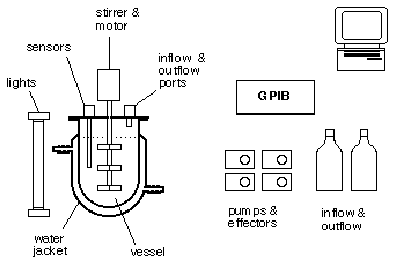
FIGURE 1. Bioreactor components
Our final design of the bioreactor consists of: a water-jacketed vessel; sensors; inflow and outflow ports; a stirrer motor, shaft, and impellers; effectors (e.g. pumps for inflows and outflows); a lighting jacket; and computer interface equipment.
The control sub-system includes components responsible for the control of the four major environmental factors:
1. mixture concentrations (dissolved ions and population density)
2. temperature
3. light intensity
4. mixing
FIGURE 7. Bioreactor control subsystem
The bioreactor control sub-system includes components to effect the control of the four major environmental factors: mixture concentrations, temperature, light intensity, and mixing.
Constant flow rate peristaltic pumps control the inflow of ions and growth medium and for the outflow of waste medium. Inflow tubes are suspended in the airspace above the liquid; outflow tubes are submerged below the liquid line.
Variable flow rates are achieved by a combination of: adjusting the roller rpm setting (manual adjustment); changing the peristaltic tubing size (manual adjustment); and by turning the pumps on and off (effected by the computer).
We purchased two models of peristaltic pumps:
1. low flow rate (VWR 54846-060): 0.03 mL/min. to 8.20 mL/min.
2. medium flow rate (VWR 54856-075): 4.0 mL/min. to 85.0 mL/min.
See Appendix II for detailed pump specifications.
During computerized manual pump control tests (manually turning pumps on and off through the computer), the minimum achievable flow volume was approximately 0.001mL for the low flow rate pump (0.15mL for the medium flow rate pump); however, the average flow volume between sending the "off" signal from the computer and the time that the pump actually stopped pumping was approximately 0.0005mL (0.067mL for the medium flow rate pump). From this, we conclude that inflows and outflows can be accurately controlled.
The water circulates in a closed loop "water circuit" at a constant flow rate of 3.0 gallons per minute. The plastic tubing is standard laboratory tubing which resists temperatures within the water jacket operating range.
Heat is added to the circuit by heating tape. The heating tape is wrapped around a 10" long glass tube (inner diameter = 1", outer diameter = 1.5") which is connected at either end to the tubing.
Heat is removed from the circuit by a cooling rod which has been supplied by the sponsor. The cooling rod has dimensions lenght = 4" and diameter = 1". It provides a constant 0 degrees celcius to the mixing bath in which it is submerged.
Temperature control of the water is provided by turning the heating tape on and off. While the tape alone will heat up to 400C, a variac provides manual control, allowing for precise calibration of the system. Flow control for the water jacket is provided by an aquarium pump. While the water must remain clean, its absolute purity is not critical and it does not pose a corrosive threat to the pump. For these reasons, a standard pump can be used, which is less expensive than the peristaltic pumps chosen for the contamination sensitive and often reactive dissolved ions. The pump is submerged in the mixing bath, providing positive pressure to the water flowing out of the mixing bath, through the heating tube and into the water jacket.
- Flow rate control:
- Dripping would take advantage of gravity, and let fluids drip into and out of the bioreactor vessel. However, this method offers little control over flow rates and directions (in the case of back flow), unless a mechanism was included to actively change the elevations of inflow and outflow bottles.
- The use of pumps allows for precise electronic flow control, independent of gravity and of the physical configuration (relative elevations) of the system. This is necessary because the system needs to function independently of lab configuration (it may get moved around). This also provides a more modular design and better lends itself to any future modifications to the entire bioreactor system.Peristaltic pumps are non-contaminating (rollers squeeze the outer walls of the pump tubing, never coming into contact with the fluid) and non-damaging to the organisms being grown.
"Back-flow" and "clump" control:
- inflow tubes suspended in the gaseous headspace of the vessel, above the liquid
- one-way valves in flow line
We chose to use peristaltic pumps to control all flows. Constant flow rate peristaltic pumps were selected for the inflow of ions and growth medium and for the outflow of waste medium. Control of backflow and cyanobacteria clumping was achieved by suspending inflow tube ends in the headspace and by inserting one-way valves into the flow lines.
Variable inflow and outflow rates are obtained by a combination of the following: adjusting the rpm setting of the peristaltic rollers (i.e., the speed at which fluid is being squeezed through the peristaltic tubing); changing the peristaltic tubing size (increasing or decreasing the tubing inner diameter); and by turning the pumps on and off.
Required flow rates are listed below:
USAGE REQUIRED
FLOW RATE (mL/min)
ion inflow s 1.0
growth medium inflow 24.5
waste medium outflow 24.5
(See Appendix ***** for peristaltic pump performace specifications.)